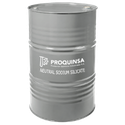
Sodium silicates are produced by melting sodium carbonate (Na2CO3) with specially selected silica sand at high temperatures. The resulting product is an amorphous crystal that can be dissolved by special processes to produce solutions in a wide variety of forms.
Composition
Table
Ingredients
Synonym
Nº CAS
%
EC Nº
Sodium Silicate
Sodium Salt of Silicic Acid
1344-09-8
36.00 – 47.0
215-687-4
Water
Balance
Applications
In the paper and cardboard industry:
In paper recycling, it aids in the dispersion and suspension of ink particles during the deinking process; it is also used in pulp bleaching with hydrogen peroxide, where it helps stabilize the pH, thereby making the bleaching process more efficient.
They are recommended for use as adhesives due to their higher content of polymeric silica. When they lose small amounts of water, they transition from a liquid to a semisolid state, becoming sticky, and then harden rapidly, forming a strong and durable bond.
In the textile industry:
In bleaching operations, the stabilizing property of silicate reduces the decomposition rate of the bleaching agent.
In the construction industry:
When silicates are combined with cementitious ingredients, they react chemically to form mixtures with strong binding properties.
Silicates increase resistance to chemical attack, which is why they are important ingredients in the manufacture of special refractories and mortars.
They are fire retardants, waterproofing agents, non-flammable, and can withstand high temperatures.
In the paint industry:
It controls the viscosity of the liquid system, providing a thickening effect that results in a very stable system.
In soil stabilization:
Sodium silicate is used to stabilize soils that lack the strength to bear the required load or in cases where pores in the subsoil (which are permeable to water) cause flooding in mines, wells, and tunnels. It is also used to prevent water loss in dams or to seal pores in drainage systems or underground structures.
In mining:
The primary use of sodium silicate in mineral flotation is as a depressant and dispersant for siliceous minerals.